
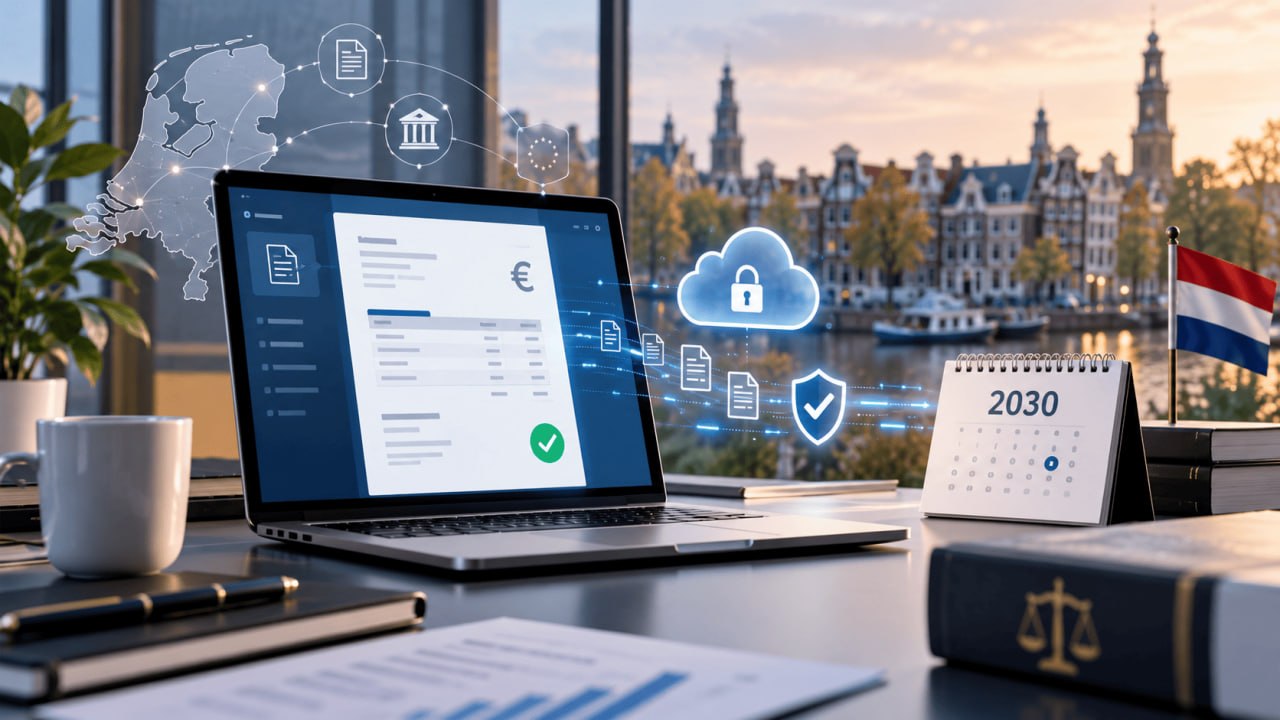
E-invoicing in the Netherlands is set to become an increasingly important issue for businesses preparing for upcoming European digital reporting requirements. With mandatory e-invoicing expected to play a greater role from 2030, businesses trading with Dutch companies should start reviewing their invoicing systems, VAT processes and compliance procedures to prepare for the changes.
See the official government announcement.
The proposed changes form part of the European Union’s VAT in the Digital Age (ViDA) reform package, which aims to modernise VAT reporting, reduce tax fraud and improve the efficiency of cross-border trade.
The reforms will affect businesses involved in cross-border transactions within the EU. The Netherlands also intends to extend mandatory e-invoicing to domestic B2B transactions, with domestic digital reporting planned from 1 July 2031.
The national legislation is still being developed, so businesses should monitor further announcements before making final compliance decisions.
What Is Changing Under the New Dutch VAT Rules?
The proposed changes will introduce new requirements for businesses to issue electronic invoices and report transaction information digitally.
The main developments are:
- Mandatory e-invoicing: Businesses carrying out relevant cross-border B2B transactions within the EU will need to use compliant electronic invoices.
- Digital VAT reporting: Transaction information will be reported digitally to the relevant tax authorities.
- Domestic requirements: The Netherlands plans to extend e-invoicing to domestic B2B transactions from 1 July 2030 and digital reporting from 1 July 2031.
- Greater VAT transparency: Tax authorities will have access to more timely and detailed transaction information, supporting more effective VAT compliance checks.
These measures are intended to reduce inconsistencies between national reporting systems and make VAT administration more efficient across the EU.
Is a PDF Invoice Sufficient?
One important point for businesses is that an electronic invoice is not simply a PDF invoice sent by email.
A compliant e-invoice contains structured data that can be transmitted and processed automatically by accounting software. This enables invoice information to be exchanged between systems without manually entering the details.
Businesses relying on spreadsheets, emailed PDFs or manual bookkeeping may therefore need to review their existing invoicing processes and accounting software.
The exact technical requirements and implementation arrangements for the Dutch domestic system will depend on the final legislation and guidance.
Which Businesses Will Be Affected?
The changes are particularly relevant to:
1. Dutch VAT-registered businesses
Companies established in the Netherlands should assess whether their current invoicing and accounting systems can support structured electronic invoicing and digital reporting.
2. Overseas businesses trading with Dutch companies
Businesses established outside the Netherlands but involved in relevant cross-border B2B transactions within the EU should review how they issue invoices and report VAT. Businesses should not assume that being established outside the Netherlands automatically excludes them from the new EU requirements.
3. Companies involved in intra-EU trade
Businesses selling goods or services to VAT-registered customers in other EU Member States should prepare for changes to invoice formats, transaction reporting and record-keeping.
4. Accountants and tax advisers
Accounting professionals should review their clients’ invoicing processes, identify potential software changes and help businesses understand how the new requirements may affect their VAT compliance obligations.
The precise scope of the Dutch domestic rules, including exemptions, will need to be confirmed through the final legislation.
Are Any Businesses Exempt from the New Dutch E-Invoicing Rules?
The Dutch government has indicated that businesses using the small-business scheme (Kleineondernemersregeling or KOR), with annual turnover of up to €20,000, will remain exempt from the planned domestic e-invoicing and digital reporting requirements.
The final legislation will determine the precise scope of the rules and any applicable exceptions. Businesses should check whether they qualify for an exemption rather than assuming that all businesses are subject to identical requirements.
How Does This Relate to the EU ViDA Reform?
The Netherlands’ plans are part of the wider EU VAT in the Digital Age package.
Under the EU reforms, mandatory e-invoicing and digital reporting for relevant cross-border B2B transactions are scheduled to begin on 1 July 2030. The objective is to create a more consistent approach to reporting cross-border transactions across Member States.
The reforms are also intended to improve the detection of VAT fraud by enabling tax authorities to receive more timely transaction data.
Businesses operating in several EU countries should consider the wider ViDA timetable alongside any additional national requirements.
How Should Businesses Prepare for Mandatory E-Invoicing?
Although 2030 may seem a long way off, early preparation can help businesses avoid unnecessary disruption and costs.
We recommend that businesses:
- Review current invoicing procedures. Identify how sales invoices and purchase invoices are created, received and processed.
- Check accounting software compatibility. Ask your software provider whether the system will support the relevant e-invoicing standards and digital reporting requirements.
- Review cross-border transactions. Identify sales and purchases involving Dutch VAT registration, Dutch customers and other EU businesses.
- Assess internal controls. Consider how invoice accuracy, VAT treatment, customer VAT numbers and transaction records will be checked.
- Monitor legislative developments. Review further Dutch government announcements and EU guidance as the implementation details become clearer.
Early preparation will give businesses more time to assess their options, train staff and make any necessary changes to their systems.
Key Dates to Remember
- 1 July 2030: Planned start of mandatory e-invoicing and digital reporting for relevant cross-border B2B transactions under the EU ViDA reforms. The Netherlands also plans to introduce domestic B2B e-invoicing from this date.
- 1 July 2031: Planned start of mandatory digital reporting for domestic B2B transactions in the Netherlands.
- Before summer 2027: The Dutch government expects to submit its national legislative proposal to Parliament.
These dates reflect the current announced plans. Businesses should check the final legislation and official guidance as they become available.
How Can We Help?
The introduction of mandatory e-invoicing represents an important development for businesses trading with the Netherlands and other EU countries.
Reviewing invoicing processes and accounting software in advance can help businesses prepare for the new requirements and maintain effective VAT compliance.
If your business is registered for VAT in the Netherlands or trades with Dutch customers, professional advice can help you understand how the proposed changes may affect your invoicing, reporting and VAT obligations.
Contact our team to discuss your Dutch VAT compliance requirements and prepare for upcoming changes to EU VAT reporting.
Businesses trading in the Netherlands should also review their wider VAT compliance obligations. Visit our Netherlands VAT Services page to learn more about Dutch VAT registration, filing requirements and ongoing compliance support for your business.
This article is for general information purposes only and reflects announced plans as at October 2026. The Dutch national legislation and detailed implementation requirements remain subject to further development. Businesses should seek advice based on their individual circumstances.
Need Expert Advice?
Need help with your accounts or VAT?
Speak with our team for practical, straightforward advice.
Contact Us