
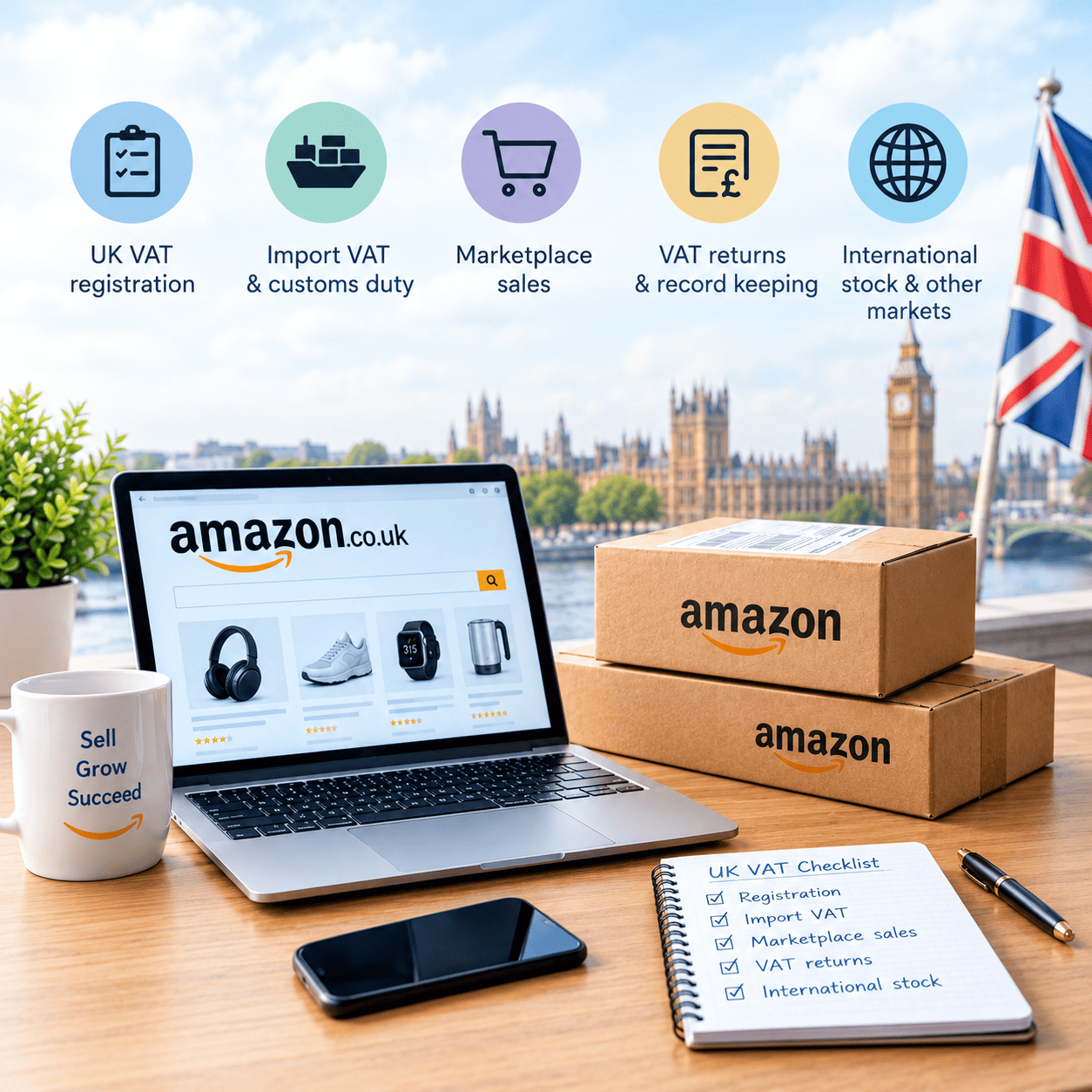
Selling on Amazon UK can provide overseas businesses with access to a large customer base without the need to establish a physical presence in the United Kingdom. However, selling through an online marketplace does not remove every UK VAT obligation.
Overseas sellers may need to register for VAT, account for import VAT, maintain accurate records and submit VAT returns, depending on where their goods are stored, how orders are fulfilled and who their customers are.
Understanding these requirements from the beginning can help businesses avoid unexpected tax liabilities, administrative problems and potential penalties.
In this article, we explain five common UK VAT mistakes overseas Amazon sellers should avoid.
1. Assuming Amazon handles all VAT obligations
One of the most common misconceptions among overseas sellers is that Amazon automatically takes care of all their UK VAT responsibilities.
Amazon may be responsible for accounting for VAT on certain sales made through its marketplace. For example, where an overseas seller sells goods that are already located in the UK to UK consumers through an online marketplace, the marketplace is generally responsible for accounting for VAT on the retail sale.
However, this does not mean that the seller has no VAT obligations.
The seller may still need to consider:
- UK VAT registration requirements.
- Import VAT and customs duty when goods enter the UK.
- VAT recovery on eligible business expenses and imports.
- VAT returns and supporting records.
- Sales to VAT-registered business customers.
- Sales made outside the marketplace.
For example, an overseas business importing products into a UK fulfilment centre may incur import VAT and customs duty before Amazon stores and dispatches the goods. The seller remains responsible for ensuring that the import declaration is correct and that any import VAT recovery is properly supported.
The VAT treatment also differs depending on whether the seller is established in the UK, where the goods are located at the time of sale and whether the customer is a consumer or a VAT-registered business.
What should you do?
Review your Amazon sales arrangements and identify which VAT obligations remain your responsibility.
HMRC guidance: Charging VAT when using an online marketplace to sell goods to customers in the UK.
2. Failing to register for UK VAT when storing goods in the UK
Many overseas businesses use Amazon’s Fulfilment by Amazon (FBA) service. Under this arrangement, products can be stored in fulfilment centres and dispatched to customers when orders are received.
Using FBA can create additional VAT considerations because the location of the stock affects the VAT treatment of subsequent sales.
An overseas seller that makes taxable sales directly to UK customers generally needs to register for UK VAT without relying on the normal domestic VAT registration threshold.
Where goods are sold through Amazon, the position requires more careful consideration. The marketplace may account for VAT on certain sales to consumers, but the seller can still have registration and reporting obligations, particularly when selling to VAT-registered businesses or making sales outside the marketplace.
For example, an overseas company may import goods into the UK, store them in an Amazon fulfilment centre and sell them to both consumers and business customers.
The marketplace may account for VAT on qualifying consumer sales, while the seller remains responsible for the VAT treatment of qualifying sales to UK VAT-registered businesses and other transactions for which the seller is liable.
Businesses should also distinguish between holding stock in the UK and simply dispatching goods from overseas. The VAT treatment of goods imported from abroad and sold through an online marketplace can differ from the treatment of goods already located in the UK when sold.
What should you do?
Before sending inventory to a UK fulfilment centre, review your registration requirements, intended sales channels and import arrangements.
Our UK VAT registration service can help overseas businesses assess their registration requirements and establish the appropriate VAT compliance arrangements.
HMRC guidance: VAT obligations for overseas businesses using an online marketplace.
3. Overlooking import VAT recovery
Import VAT is an important consideration for overseas Amazon sellers importing goods into the UK.
When goods are imported into Great Britain from outside the UK, import VAT and, where applicable, customs duty may arise. The amount depends on factors including the customs value, commodity classification and applicable duty rate.
Import VAT can represent a significant cost, particularly for businesses importing large quantities of inventory.
However, eligible VAT-registered businesses may be able to recover import VAT through their UK VAT returns, subject to the normal input tax recovery rules.
To support a claim, businesses should ensure that:
- The import relates to their business activities.
- The goods are used for transactions that allow input VAT recovery.
- The business is correctly identified in the relevant import documentation.
- Appropriate evidence of the import VAT is retained.
- The amount claimed agrees with the supporting records.
Postponed VAT Accounting (PVA) may also be available for eligible imports. Rather than paying import VAT at the point of importation, the importer accounts for it through its VAT return. Subject to the normal recovery rules, the corresponding input VAT can be reclaimed on the same return.
For example, an overseas seller importing inventory into Great Britain may be able to account for import VAT using PVA, improving cash flow compared with paying the import VAT upfront.
However, PVA does not remove the need to make a correct customs declaration or meet the conditions for input VAT recovery.
It is also important to distinguish import VAT from customs duty. Customs duty is not input VAT and cannot be reclaimed through a VAT return.
What should you do?
Review your import declarations, postponed import VAT statements and VAT return calculations regularly. Check that the importer details are correct and that any import VAT claimed is supported by appropriate evidence.
4. Relying solely on Amazon reports when preparing VAT returns
Amazon provides sellers with transaction reports, settlement reports and other financial information. These reports are useful, but they should not automatically be treated as a complete VAT accounting record.
Amazon settlements often combine several different transactions, including:
- Customer sales.
- Refunds and cancellations.
- Selling and fulfilment fees.
- Advertising charges.
- Storage fees.
- Reimbursements and adjustments.
- Amounts withheld or deducted from payouts.
The amount paid into a seller’s bank account is therefore not necessarily the correct figure to report as sales in a VAT return.
For example, if a seller makes £20,000 in sales and Amazon deducts £5,000 in fees before paying the balance, the net settlement of £15,000 does not represent the seller’s gross sales figure.
The VAT treatment of the sales, fees and adjustments must be considered separately. The VAT treatment of Amazon’s fees will also depend on the nature of the service, the supplier’s location and the applicable place-of-supply rules.
For overseas sellers, another important issue is identifying which transactions Amazon has accounted for VAT on and which remain the seller’s responsibility.
This is particularly relevant where a seller makes sales to UK VAT-registered businesses, sells directly to customers or holds stock in different countries.
What should you do?
Reconcile Amazon transaction data to your accounting records and VAT returns. Retain sufficient information to identify the nature of each transaction, the relevant VAT treatment and the supporting evidence.
A proper reconciliation can help identify errors, missing transactions and discrepancies between marketplace reports and the amounts reported to HMRC.
5. Ignoring VAT obligations in other countries
Selling on Amazon UK can be part of a wider international e-commerce strategy. Many overseas businesses also sell through Amazon marketplaces in Germany, France, Italy, Spain, Ireland and other countries.
However, a UK VAT registration does not automatically cover sales or stock held in other jurisdictions.
For example, storing inventory in an EU country may create local VAT registration and reporting requirements. Moving stock between countries can also have VAT implications, even when the transfer does not involve a sale to an external customer.
Businesses selling to consumers across the EU may be able to use the One Stop Shop (OSS) scheme for eligible cross-border B2C sales. However, OSS does not replace every domestic VAT registration or reporting obligation, particularly where a business holds stock in another country.
Northern Ireland also has specific VAT rules for certain movements of goods between Northern Ireland and the EU. These rules should be considered separately from the arrangements that apply to goods sold in Great Britain.
The correct treatment depends on the seller’s location, where the goods are stored, the route taken by the goods, the customer type and the nature of the transaction.
What should you do?
Map your supply chain and identify where inventory is stored, where goods are sold from and which countries are involved in your transactions.
If you sell across multiple markets, consider obtaining a review of your VAT registrations, reporting obligations and cross-border stock movements.
How can a UK VAT specialist help your Amazon business?
Managing VAT for an international e-commerce business involves more than registering for VAT and submitting periodic returns.
A VAT specialist can help you:
- Assess whether UK VAT registration is required.
- Review the VAT treatment of Amazon marketplace sales.
- Understand import VAT recovery and Postponed VAT Accounting.
- Reconcile Amazon reports with your accounting records.
- Identify VAT risks arising from stock held in different countries.
- Prepare and submit UK VAT returns.
- Respond to HMRC queries and review historical VAT reporting where necessary.
Getting the VAT treatment right from the outset can help reduce compliance risks and give you greater confidence as your business grows.
Need help with UK VAT registration or Amazon VAT compliance?
If your business is based outside the UK and sells through Amazon UK, we can help you understand your UK VAT obligations and establish an appropriate compliance process.
Whether you need VAT registration, assistance with ongoing VAT returns or a review of your existing arrangements, our team can discuss your requirements.
Contact us to discuss your UK VAT requirements and how we can support your business.
Explore our UK VAT registration services or learn more about our VAT returns services.
This article provides general information on UK VAT rules and is not a substitute for advice based on your individual business circumstances. VAT treatment depends on the facts of each transaction and the applicable legislation and HMRC guidance.
Need Expert Advice?
Need help with your accounts or VAT?
Speak with our team for practical, straightforward advice.
Contact Us